
Glossary
A
Ajax
Ajax (also known as AJAX), shorthand for Asynchronous JavaScript and XML, is a web development technique for creating interactive web applications. The intent is to make web pages feel more responsive by exchanging small amounts of data with the server behind the scenes, so that the entire web page does not have to be reloaded each time the user requests a change. This is meant to increase the web page's interactivity, speed, and usability. Read more on Ajax
Apache
Apache HTTP Server, product of the Apache Software Foundation is a free software/open source web server for Unix-like systems, Windows, Novell NetWare and other platforms. Apache is notable for playing a key role in the initial growth of the World Wide Web, and continues to be the most popular web server in use, serving as the de facto reference platform against which other web servers are designed and judged. Apache is primarily used to serve static and dynamic content on the World Wide Web. Many web applications are designed expecting the environment and features that Apache provides. Apache is the web server component of the popular LAMP web server application stack, alongside Linux, MySQL, and the PHP/Perl/Python programming languages.
Antispam
See Spamassassin
Antivirus
See ClamAV
ActivityPub
An open protocol used by Fediverse services to exchange posts, comments and follows between independent servers.
Aider
A command-line AI assistant that can help edit and maintain code directly inside a hosting environment. Website: aider.chat.
AUP
Acceptable Use Policy. The rules that define what is allowed and not allowed on all2all services.
ACME
Automatic Certificate Management Environment. A protocol used by Let's Encrypt and similar services to issue and renew TLS certificates automatically.
B
Backup
In the field of information technology, backup refers to the copying of data so that these additional copies may be restored after a data loss event. Backups differ from archives and backup systems differ from fault-tolerant systems. Backups are useful primarily for two purposes: to restore a computer to an operational state following a disaster (called disaster recovery) and to restore small numbers of files after they have been accidentally deleted or corrupted. Read also our FAQ: How does the all2all backup system work?
Database
Often abbreviated DB. A collection of information organized in such a way that a computer program can quickly select desired pieces of data. You can think of a database as an electronic filing system. Traditional databases are organized by fields, records, and files. A field is a single piece of information; a record is one complete set of fields; and a file is a collection of records. For example, a telephone book is analogous to a file. It contains a list of records, each of which consists of three fields: name, address, and telephone number. An alternative concept in database design is known as Hypertext. In a Hypertext database, any object, whether it be a piece of text, a picture, or a film, can be linked to any other object. Hypertext databases are particularly useful for organizing large amounts of disparate information, but they are not designed for numerical analysis. To access information from a database, you need a database management system (DBMS). This is a collection of programs that enables you to enter, organize, and select data in a database like MySQL or PostgreSQL.
BIND
BIND (Berkeley Internet Name Domain) is the most commonly used DNS server on the Internet, especially on Unix-like systems, where it is a de facto standard. The resolver library included in the BIND distribution provides translations between domain names (used by humans) and Internet addresses (used by machines). This process is called DNS resolution and is linked with applications requiring name service.
Blog
A blog (short for web log) is a web application where entries are made and displayed in a reverse chronological order. A typical blog combines text, images, and links to other blogs, web pages, and other media related to its topic. The ability for readers to leave comments in an interactive format is an important part of most early blogs. Most blogs are primarily textual although some focus on photographs (photoblog), videos (vlog), music (MP3 blog), or audio (podcasting), and are part of a wider network of social media. Here are some exemples of free blog softwares : WordPress, DotClear, Blog:CMS, ...
BNIX
The BNIX (Belgian National Internet eXchange) was established in 1995 by the national research network BELNET. It is the node on which Internet Service Providers (ISPs) exchange their Internet traffic in Belgium. BNIX greatly improves the quality of the local connections by offering faster, shorter, uncongested and cheap links between the ISPs.
BGP
Border Gateway Protocol. The routing protocol that lets networks exchange routes on the Internet.
BigBlueButton
Free software for online classes, webinars and video conferences, usually installed on a dedicated server.
C
cron
cron is the standard Unix/Linux scheduler for running commands automatically at fixed times, for example backups, maintenance scripts or regular synchronisation tasks.
CGI
The Common Gateway Interface (CGI) is a standard protocol for interfacing external application software with an information server, commonly a web server. This allows the server to pass requests from a client web browser to the external application. It's generally a CGI script that deals with the input of a form on a Web page and return the output from the application to the web browser.
ClamAV
Clam AntiVirus (ClamAV), is a widely used free antivirus software toolkit for Unix-like operating systems. It is mainly used with a mail exchange server as a server-side email virus scanner. ClamAV is open source software distributed under the terms of the GNU General Public License (GPL). Both ClamAV and its updates are made available free of charge. ClamAV is generally configured to automatically update its list of virus definitions via the Internet (see : http://www.clamav.net).
CMS
A Content Management System (CMS) is a software system for organizing and facilitating collaborative creation of documents and publishing websites. A web content management system is often used to manage and control a large, dynamic collection of web material (HTML documents and their associated images). A CMS facilitates document editing. It offers standard visual templates that can be automatically applied to new and existing content, creating one central place to change that look across a group of content on a site. Most CMS software include WYSIWYG editing tools allowing non-technical individuals to create and edit content. Active CMS solutions usually receive regular updates that include new feature sets and keep the system up to current web standards. The most commons free CMS are : Joomla!, Spip, Drupal, BitFlux, eZPublish, Plume, Typo3, Postnuke ...
CNAME record
A DNS alias record. It points one hostname to another hostname instead of directly to an IP address.
D
Database
Often abbreviated DB. A collection of information organized in such a way that a computer program can quickly select desired pieces of data. You can think of a database as an electronic filing system. Traditional databases are organized by fields, records, and files. A field is a single piece of information; a record is one complete set of fields; and a file is a collection of records. For example, a telephone book is analogous to a file. It contains a list of records, each of which consists of three fields: name, address, and telephone number. An alternative concept in database design is known as Hypertext. In a Hypertext database, any object, whether it be a piece of text, a picture, or a film, can be linked to any other object. Hypertext databases are particularly useful for organizing large amounts of disparate information, but they are not designed for numerical analysis. To access information from a database, you need a database management system (DBMS). This is a collection of programs that enables you to enter, organize, and select data in a database like MySQL or PostgreSQL.
DNS
Short for Domain Name System (or Service or Server), an Internet service that translates domain names into IP addresses. Because domain names are alphabetic, they're easier to remember. The Internet however, is really based on IP addresses. Every time you use a domain name, therefore, a DNS service must translate the name into the corresponding IP address. For example, the domain name www.example.com might translate to 198.168.0.154. The DNS system is, in fact, its own network. If one DNS server doesn't know how to translate a particular domain name, it asks another one, and so on, until the correct IP address is returned. The BIND DNS server is a very popular and free DNS server. When setting up a new web site one needs to register a DNS name at a DNS registry. One site can have serveral DNS names, also called server aliases.
DAC
Direct Attach Copper. A short, low-power cable used to connect network equipment at high speed.
DKIM
A mail signature system that helps receiving mail servers verify that a message was really sent by an authorised domain.
DMARC
A mail policy that tells receiving servers what to do when SPF or DKIM checks fail.
DNSSEC
Security extensions for DNS that help verify that DNS answers have not been altered.
E
eBGP
External BGP. BGP used between different networks, for example between all2all and an upstream transit provider.
Elementor
A visual page builder for WordPress, useful for more designed pages but heavier than the standard editor.
EPP
Extensible Provisioning Protocol. The protocol used by registrars to register, transfer and manage domain names with registries.
F
Free
Free software is a term coined by Richard Stallman and the Free Software Foundation (FSF) to refer to software that can be used, studied, and modified without restriction, and which can be copied and redistributed in modified or unmodified form either without restriction, or with certain requirements to ensure that further recipients also get these freedoms. To make software available as free software, the software has to be accompanied by a software licence saying that the copyright holder allows these acts (a free software licence), and the human readable form of the program (the source code) must be made available. The GNU General Public License aka GPL, is one of the most popular free software license.
FTP
FTP or file transfer protocol is a commonly used protocol for exchanging files over any network that supports the TCP/IP protocol (such as the Internet or an intranet). There are two computers involved in an FTP transfer : a server and a client. FTP is most commonly used to upload a file defining a Web page to a Web server using the Internet. A secure variante of FTP using SSL or TLS is FTPS. To access a FTP server, one uses a FTP client software (with a graphical interface or directly through command lines) such as gFTP or Filezilla. They both also support the SCP protocol.
Fediverse
A network of independent social platforms that can communicate with each other using open protocols.
FRRouting
Free routing software for Linux, used for protocols such as BGP and OSPF.
×Flash / Red5
Historical streaming stack: Flash video and Red5 are obsolete for public web video. Today, use HTML5/HLS, Owncast, PeerTube, BigBlueButton or Jitsi depending on the use case.
G
GIT
In software development, Git (/ɡɪt/) is a distributed revision control and source code management system with an emphasis on speed. Git was initially designed and developed by Linus Torvalds for Linux kernel development. Every Git working directory is a full-fledged repository with complete history and full revision tracking capabilities, not dependent on network access or a central server. Git is free software distributed under the terms of the GNU General Public License version 2
GNU
See Free software
GPL
See Free software
Glue record
A glue record is an particular kind of A (address) record in a DNS zone file. If a zone is delegated to a name server, and the name server's own hostname is part of that zone, a glue record for that hostname must be included. Example: if you have an all2all virtual server named mydomain.net, then dns.mydomain.net will act as the name server for the mydomain.net domain. Therefore a glue record including the IP address of the server should be added to the zone file.
GDPR
European data protection law. It defines how personal data must be collected, processed and protected.
Gutenberg
The standard block editor in WordPress.
H
HTML5
HTML5 is the current family of web standards for structuring web pages and embedding audio or video directly in the browser without obsolete plugins.
HTTPS
HTTPS is HTTP protected by TLS encryption. It is the normal way to publish websites securely and is commonly enabled with Let’s Encrypt certificates.
High-availability cluster
High-availability clusters (also known as HA Clusters or Failover Clusters) are computer clusters that are implemented primarily for the purpose of providing high availability of services which the cluster provides. An example of a high availability setup could be a redundant LAMP server (Linux, Apache, MySQL, PHP) or email server. They operate by having redundant computers or nodes which are then used to provide service when system components fail. Normally, if a server with a particular application crashes, the application will be unavailable until someone fixes the crashed server. HA clustering remedies this situation by detecting hardware/software faults, and immediately restarting the application on another system without requiring administrative intervention, a process known as Failover. As part of this process, clustering software may configure the node before starting the application on it. For example, appropriate filesystems may need to be imported and mounted, network hardware may have to be configured, and some supporting applications may need to be running as well.
HA clusters are often used for critical databases, file sharing on a network, business applications, and customer services such as electronic commerce websites.
HA cluster implementations attempt to build redundancy into a cluster to eliminate single points of failure, including multiple network connections and data storage which is multiply connected via Storage area networks.
HA clusters usually use a heartbeat private network connection which is used to monitor the health and status of each node in the cluster. One subtle, but serious condition all clustering software must be able to handle is split-brain. Split-brain occurs when all of the private links go down simultaneously, but the cluster nodes are still running. If that happens, each node in the cluster may mistakenly decide that every other node has gone down and attempt to start services that other nodes are still running. Having duplicate instances of services may cause data corruption on the shared storage.
HA clusters usually utilize all available techniques to make the individual systems and shared infrastructure as reliable as possible. These include:
- Disk mirroring so that failure of internal disks does not result in system crashes.
- Redundant network connections so that single cable, switch, or network interface failures do not result in network outages.
- Redundant Storage area network or SAN data connections so that single cable, switch, or interface failures do not lead to loss of connectivity to the storage (this would violate the share-nothing architecture).
- Redundant electrical power inputs on different circuits, usually both or all protected by Uninterruptible power supply units, and redundant power supply units, so that single power feed, cable, UPS, or power supply failures do not lead to loss of power to the system.
The most common size for an HA cluster is a two-node cluster, since that's the minimum required to provide redundancy, but many clusters consist of many more, sometimes dozens of nodes:
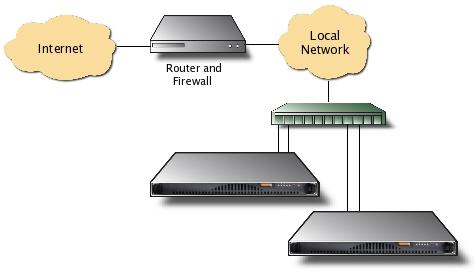
These features help minimize the chances that the clustering failover between systems will be required. In such a failover, the service provided is unavailable for at least a little while, so measures to avoid failover are preferred.
Hot-swap
Hot swapping or hot plugging is the ability to remove and replace components of a server while it is operating. Particularily useful for replacing hard discs, a hot-swap server case gives the opportunity to unplug a default disc and plug a new one without stopping the system. This option is highly recommended to avoid interruptions of service due to hard disc failure.
×HTML
Historical note: this old entry describes pre-HTML5 history. HTML is still the basic language of the web, but the current practical standard is HTML5.
HTML, short for Hypertext Markup Language, is the predominant markup language for the creation of web pages. It provides a means to describe the structure of text-based information in a document — by denoting certain text as headings, paragraphs, lists, and so on — and to supplement that text with interactive forms, embedded images, and other objects. HTML is written in the form of labels (known as tags), surrounded by less-than and greater-than signs. Technically is HTML an application of the Standard Generalized Markup Language (SGML). The HTML development has been stopped since 1999. It's successor, the XHTML, is an application of the Extensible Markup Language (XML).
HTTP
Hypertext Transfer Protocol (HTTP) is a method used to transfer or convey information on the World Wide Web. Its original purpose was to provide a way to publish and retrieve HTML pages. HTTP is a request/response protocol between clients and servers. The originating client, such as a web browser, initiates a request by establishing a Transmission Control Protocol (TCP) connection to a particular port on a remote host (port 80 by default). The destination HTTP server listening on that port, which stores resources such as HTML files and images, waits for the client to send a request message. HTTPS (with S for secure) is the sercure variation of HTTP that use an added encryption layer of SSL or TLS to protect the traffic.
HLS
HTTP Live Streaming. A common web standard for delivering video streams through normal web servers and browsers.
Hugo
A static site generator. It builds web pages from templates and Markdown files without requiring a database.
I
Icecast
Icecast is free streaming server software for publishing live or on-demand audio streams using open formats and standard web clients.
iCALENDAR
See WebDAV
IMAP
The Internet Message Access Protocol, commonly known as IMAP, is an application layer Internet protocol that allows a local client to access e-mail on a mail server without dowloading it. In other words, it permits a "client" email program to access remote message stores as if they were local. That's why email stored on an IMAP server can be manipulated from a desktop computer at home, a workstation at the office, and a notebook computer while traveling, without the need to transfer messages or files back and forth between these computers. IMAP's ability to access messages from more than one computer has become extremely important as reliance on electronic messaging and use of multiple computers increase. Think about webmail, for instance, that allows one to read his e-mails in a cybercafé. IMAP is using the TCP port 143. IMAPS (IMAP over SSL) gives a secure access to the server via SSL. It is using the TCP port 993.
iBGP
Internal BGP. BGP used inside one network to distribute routes between routers.
ICANN
The international organisation that coordinates global domain name and IP address policies.
J
Java
Java is an object-oriented applications programming language developed by Sun Microsystems in the early 1990s. Java applications are typically compiled to bytecode, although compilation to native machine code is also possible. At runtime, bytecode is usually either interpreted or compiled to native code for execution, although direct hardware execution of bytecode by a Java processor is also possible. The Java Runtime Environment or JRE is the software required to run any application deployed on the Java Platform. End-users commonly use a JRE in software packages and Web browser plugins. One important characteristic of Java is it's platform independence, which means that programs written in the Java language must run similarly on any supported hardware/operating-system platform. One should be able to write a program once, compile it once, and run it anywhere. JavaScript, a scripting language, shares a similar name and has similar syntax, but is not directly related to Java. Sun Microsystems provides a GNU General Public License implementation of a Java compiler and Java virtual machine, in compliance with the specifications of the Java Community Process, although the class library that is required to run Java programs is not free software. The release of the complete source code under GPL is expected in 2007.
Jitsi Meet
Free software for video meetings. It can be self-hosted or used through a hosted service.
K
L
LAMP
The acronym LAMP refers to a solution stack of software programs, commonly open-source programs, used together to run dynamic Web sites on servers. The original combination of these technologies is as follows: Linux, referring to the operating system ; Apache, the Web server ; MySQL, the database management system (or database server) ; PHP, the programming language. More recently, the P has come to refer frequently to Perl or Python as alternate programming languages. At all2all, standard LAMP systems also feature PostgreSQL as alternative database.
Linux
Linux is a Unix-like computer operating system family. Linux is one of the most prominent examples of free software and of open source development; its underlying source code is available for anyone to use, modify, and redistribute freely. After the Linux kernel was released to the public on 17 September 1991 by Linus Torvald, the first Linux systems were completed by combining the kernel with system utilities and libraries from the GNU project, which led to the coining of the term GNU/Linux. all2all is using Debian GNU/Linux as basic operating system on all his server systems.
Let's Encrypt
A certificate authority that provides free TLS certificates and automated renewal for HTTPS websites.
M
Mailman
Mailman is a package for managing electronic mailing lists on a server. It is free software, distributed freely under the GNU General Public License. Mailman's chief distinction is its easy-to-use Web interface for list administration. Mailman is written in the Python programming language. It can work with any common Unix mail server software, including Postfix, Sendmail and qmail. The integration with the free mail server software exim (which is used by the Debian GNU/Linux by default) is probably best: using special configuration rules, exim knows which addresses are used by Mailman and automatically forwards all mails which are handled by Mailman to Mailman, without having to set customized aliases for each individual mailing list, as it is custom with most or all other mail servers. User features include the built-in archiving of messages, automatic processing of bounce messages, digest mode, and spam filtering. By default, Mailman sends out a reminder message on the first of the month (local time) to all subscribers (see : http://www.gnu.org/software/mailman).
×Mono
Legacy context: Mono helped run .NET applications on Linux. Today, modern .NET on Linux or containerized applications are usually the relevant path.
Mono is a free implementation of the Microsoft .NET document standard to be run on Unix-like server system. Mono is licensed under GPL, LGPL and MIT and is shipped with the Debian Etch distribution. For more details, see : http://www.mono-project.com/Main_Page
MP3
MPEG-1 Audio Layer 3, more commonly referred to as MP3, is a popular digital audio encoding format. It uses a lossy compression algorithm that is designed to greatly reduce the amount of data required to represent the audio recording, yet still sound like a faithful reproduction of the original uncompressed audio to most listeners (above 128kbps). Although people tend to think it's free because it is gratis, MP3 is a proprietary standard that was invented by a team of European engineers of Philips, CCETT, IRT and Fraunhofer Society. These patent issue significantly slowed the development of unlicensed MP3 software and led to increased focus on popularizing an alternative like the Ogg Vorbis, created by Xiph.org, with a higher quality standard.
MySQL
MySQL Community Server is a cross-platform relational SQL database server. MySQL is a multi-threaded, multi-user SQL database management system using a modular engine architecture. It is fast and rock-solid and one of the most widely used SQL engine. Both the MySQL server software itself and the client libraries are distributed under a dual-licensing format. MySQL Server is available as free software under the GNU General Public License (GPL), but the MySQL Enterprise subscription is also offering a traditional proprietary licensing arrangements for cases where the intended use is incompatible with the GPL. MySQL is a key element of the LAMP (Linux, Apache, MySQL, PHP / Perl / Python) open source software architecture for professionnals.
MariaDB
A free database server compatible with MySQL, used by many websites and applications.
MX record
A DNS record that tells the Internet which mail servers receive email for a domain.
N
Netiquette
Netiquette (neologism, a portmanteau formed from "network etiquette") is a catch-all term for the conventions of politeness and respect recognized on Usenet, in mailing lists, in live chat systems, and on other electronic forums such as Internet message boards. These conventions address the relationship between personal behavior and group phenomena, and outline a dynamic set of guidelines for conduct that is conducive to pleasant, efficient and agreeable interaction. Examples of these guidelines are not posting in all uppercase, not (cross-)posting to inappropriate groups, refraining from commercial advertising outside the biz groups and not top posting. RFC 1855 is a fairly lengthy and comprehensive set of such conventions.
Nextcloud
Free software for file sharing, calendars, contacts and collaborative tools. all2all can host it as an independent alternative to large centralised cloud platforms. Website: nextcloud.com. Background: Wikipedia.
Nextcloud Talk
Video and chat functionality inside Nextcloud, useful for simple team communication and meetings.
O
Open Source
Open source software is computer software whose source code is available under a license that permits users to study, change, and improve the software, and to redistribute it in modified or unmodified form as defined by the Open Source Initiative (OSI). The OSI was formed in February 1998 by Eric Raymond and Bruce Perens in order to present the 'open source' case to commercial businesses, like Netscape. The OSI hoped that the usage of the label "open source" would eliminate the ambiguity of the word "free" in English, particularly for individuals who perceive "free software" as anti-commercial.
Odoo
Open-source business management software. all2all uses it for customer records, subscriptions, invoices and internal workflows. Odoo Community is open source; Odoo Enterprise adds proprietary modules. Website: odoo.com.
Owncast
Free software for self-hosted live video streaming.
P
phpMyAdmin
phpMyAdmin is a web interface for managing MySQL or MariaDB databases, tables and users from a browser.
Perl
Perl is a dynamic programming language created by Larry Wall and first released in 1987. Structurally, Perl is based on the brace-delimited block style of AWK and C, and was widely adopted for its strengths in string processing, and lack of the arbitrary limitations of many scripting languages at the time. Perl has been used since the early days of the Web to write CGI scripts. It is known as one of "the three Ps" (along with Python and PHP), the most popular dynamic languages for writing Web applications (which now also include Ruby). It is also an integral component of the popular LAMP solution stack for web development. Large projects written in Perl include Slash, Bugzilla, TWiki and Movable Type.
PGP
Still relevant: today this is usually referred to as OpenPGP or GnuPG, especially for signing software releases, packages and email.
PGP Encryption (Pretty Good Privacy) is a computer program that provides cryptographic privacy and authentication. It is based on asymetric encryption (one public key + one private key) and was originally created by Philip Zimmermann in 1991. Shortly after its release, PGP encryption found its way outside the US, and in February 1993 Zimmermann became the formal target of a criminal investigation by the US Government for violating the export regulations. Since the end of the 90's, PGP encryption no longer meets the definition of a non-exportable weapon and can be exported internationally except to 7 specific countries.PGP and other similar products follow the OpenPGP standard for encrypting and decrypting data. To encrypt your messages, we advise you to use either GnuPG (for MacOS and Linux) or WinPT (for Windows).
PHP
PHP is a reflective programming language designed for producing dynamic web pages. The project's name originally stood for Personal Home Page; it now stands for the recursive initialism PHP: Hypertext Preprocessor. PHP was written by Rasmus Lerdorf in 1994 and is mainly used in server-side scripting. PHP generally runs on a web server, taking PHP code as its input and creating Web pages as output. PHP is free. It can be deployed on most web servers and on almost every OS platform free of charge. The PHP Group also provides the complete source code for users to build, customize and extend for their own use. PHP is commonly used as the P in the LAMP software bundle alongside Linux, Apache and MySQL.
Podcast
A podcast is a digital media file, or a series of such files, that is distributed over the Internet. In other words, a podcast is a collection of audio or video files residing at a unique web feed address. People can "subscribe" to this feed by submitting the feed address to an aggregator. When new "episodes" become available in the podcast they will be automatically downloaded to the users computer. Though podcasters' web sites may also offer direct download or streaming of their content, a podcast is distinguished from other digital media formats by its ability to be syndicated, subscribed to, and downloaded automatically, using an aggregator or feed reader capable of reading feed formats such as RSS (Really Simple Syndication) or Atom.
POP3
The Post Office Protocol version 3 (POP3) is an application-layer Internet standard protocol used to retrieve e-mail from a remote server over a TCP/IP connection and store them on one's personal computer hard disc, in contrast to the IMAP protocol that leaves the messages on the server. POP3 uses TCP on network port 110. POP3S (POP3 over SSL) uses SSL to encrypt and secure the communications on port 995.
Postfix
Postfix is an open source mail transfer agent (MTA), a computer program used on servers for the routing and delivery of e-mail. It is intended as a fast, easy-to-administer, and secure alternative to the widely-used Sendmail MTA. Postfix is the default MTA for a number of Unix(-like) operating systems. It is released under the IBM Public License 1.0 which is a free software licence. One of the strengths of Postfix is its resilience against buffer overflows. Another one is its handling of large amounts of e-mail and advanced content filtering against spams (see : http://www.postfix.org).
PostgreSQL
PostgreSQL is a free software object-relational database management system (ORDBMS), released under a BSD-style license. It offers an alternative to other database systems. Similar to other free software projects such as Apache, GNU/Linux, and MediaWiki, PostgreSQL is not controlled by any single company, but relies on a global community of developers and companies to develop it. PostgreSQL features the ability to define types, but also the ability to fully describe relationships. In PostgreSQL, the database "understood" relationships, and could retrieve information in related tables in a natural way using rules. Tables can be set to inherit their characteristics from a "parent" table. nheritance provides a way to map the features of generalization hierarchies depicted in Entity Relationship Diagrams (ERD) directly into the PostgreSQL database. Phppgadmin is a web application written with PHP to manage the PostgreSQL database.
Python
The Python programming language is actively used by many people, both in industry and academia for a wide variety of purposes. Its strengths for teaching include its syntactic simplicity, flexible typing, and interactive interpreter. Python uses fewer symbols than languages like Java and C. Plone is a user-friendly and powerful open source Content Management System, derived from the Zope application server which is relying on Python.
PeerTube
Free software for hosting and federating video platforms, including live video in some setups. Website: joinpeertube.org.
Peppol
A European network and standard for sending structured electronic invoices between organisations.
Q
Quota
A disk quota is a limit set by a system administrator that restricts certain aspects of file system usage on modern operating systems. A usage quota or block quota limits the amount of disk space that can be used. In addition, administrators usually define a warning level, or soft quota, at which users are informed they are nearing their limit, that is less than the effective limit, or hard quota. When a soft quota is violated, the system normally sends the user some sort of message. The user is then known to be "overquota". No further action can be taken because the system prevent disk write operations that would result in hard quota violations. No more files can be uploaded in the FTP repositories and no more e-mails can be received. E-mails are sent back to senders with the "overquota" indication. The solution is to delete some existing files to free some disk space or to set new quota limits.
×QuickTime Streaming
Historical streaming technology. It has been replaced on the web by HTML5 video, HLS and modern streaming services.
R
Radio
Different software solutions let you transform a server into a genuine radio studio. Most of these radio management applications are providing live studio broadcast capabilities as well as the remote automation in one integrated system. They almost all rely on Icecast or ShoutCast as audio streaming server. Amongst the most widely used free softwares to set up a radio, you will find Soma (http://www.somasuite.org/), Rivendell (http://www.rivendellaudio.org/) and Airtime (http://sourceforge.net/projects/airtime).
RAID
In computing, specifically computer storage, a redundant array of inexpensive (or independent) drives (or disks) (RAID) is an umbrella term for data storage schemes that divide and/or replicate data among multiple hard drives. They offer, depending on the scheme, increased data reliability and/or throughput. The main RAID levels used at all2all are RAID1 and RAID5. For a more complete information about the different RAID levels, please see http://en.wikipedia.org/wiki/RAID0#RAID_0. Note that a RAID system could never replace a good backup strategy.
RAID1
A RAID 1 creates an exact copy (or mirror) of a set of data on two or more disks. This is useful when read performance or reliability are more important than data storage capacity. Such an array can only be as big as the smallest member disk. A classic RAID 1 mirrored pair contains two disks, which increases reliability exponentially over a single disk. Since each member contains a complete copy of the data, and can be addressed independently, ordinary wear-and-tear reliability is raised by the power of the number of self-contained copies. When reading, both disks can be accessed independently and requested sectors can be split evenly between the disks. For the usual mirror of two disks, this would, in theory, double the transfer rate. The array continues to operate so long as at least one drive is functioning. You can change a default drive on the fly and it will synchronise automatically with the remaining one without affecting the server's job.
RAID5
RAID 5 = Striped Set with Distributed Parity. A minimum of 3 disks is required for a complete RAID 5 configuration. Distributed parity requires all but one drive to be present to operate; drive failure requires replacement, but the array is not destroyed by a single drive failure. Upon drive failure, any subsequent reads can be calculated from the distributed parity such that the drive failure is masked from the end user. The array will only have data loss in the event of a second drive failure and is vulnerable until the data that was on the failed drive is rebuilt onto a replacement drive.
×RealMedia
Historical technology: RealMedia is obsolete. Today, use HTML5/HLS, Icecast, Owncast, PeerTube or a dedicated video platform depending on the project.
RealMedia is a multimedia container format created by RealNetworks. Its extension is ".rm". It is typically used in conjunction with RealVideo and RealAudio and is popular for streaming content over the Internet. Typically these streams are in CBR (constant bit rate). Recently RealNetworks has developed a new container for VBR (variable bit rate) streams, named RealMedia variable bitrate (RMVB). Support of RealMedia is available in a wide variety of multimedia players for different architectures/platforms, including RealPlayer. Launched in 2002, the Helix initiative includes plan to release substantial parts of proprietary technologies under an open source licence. RealNetworks also announced partnership with Xiph.org to support the free software Ogg Vorbis audio codec. The code is released under various licenses, like the RealNetworks Public Source License starting in 2003 and the GPL in 2004. Not all of the source code is licensed under one of the free software licences, for example the codecs (see : https://helixcommunity.org).
RSS feed
RSS (Really Simple Syndication) is a family of web feed formats used to publish frequently updated content such as blog entries, news headlines or podcasts. An RSS document, which is called a "feed," "web feed," or "channel," contains either a summary of content from an associated web site or the full text. RSS makes it possible for people to keep up with their favorite web sites in an automated manner that's easier than checking them manually. RSS content can be read using software called a "feed reader" or an "aggregator." The user subscribes to a feed by entering the feed's link into the reader or by clicking an RSS icon in a browser that initiates the subscription process. The reader checks the user's subscribed feeds regularly for new content, downloading any updates that it finds.
Ruby on Rails
Ruby on Rails is a web application framework, released in 2004, that aims to increase the speed and ease with which database-driven web sites can be created and offers skeleton code frameworks (scaffolding) from the outset. Often shortened to Rails, or RoR, Ruby On Rails is an open source project written in the Ruby programming language and applications using the Rails framework are developed using the Model-View-Controller design pattern. The official web site is : http://www.rubyonrails.org/
Registrant
The person or organisation that legally holds the right to use a domain name.
Registrar
An organisation that can register domain names for customers through official registries.
Registry
The organisation that manages one or more domain extensions, such as .be, .eu or .org.
Reverse charge
A VAT mechanism where the buyer, not the seller, accounts for VAT. It is often used for EU B2B services.
RDAP
Registration Data Access Protocol. A modern protocol used to query public registration information about domain names and IP addresses.
Roundcube
A webmail application that lets users read and send mail through a web browser.
S
SFTP
SFTP is file transfer over SSH. It is preferred to legacy FTP because the connection and authentication are encrypted.
Server
The client-server architecture refers to a communication model between softwares. In information technology, a server is an application program that accepts connections in order to service requests by sending back responses. Each instance of the client software can send data requests to one or more connected servers. In turn, the servers can accept these requests, process them, and return the requested information to the client. These days, clients are most often web browsers. Servers typically include web servers, database servers, backup servers, print servers, mail servers, web servers, FTP servers, application servers, DHCP server, DNS server, etc. The client-server connection is established via communication protocols like, for instance, TCP/IP, which is most often used for accessing the Internet.
SCP
SCP (Secure Copy) is a means of securely transferring computer files between a local and a remote host or between two remote hosts, using the Secure Shell (SSH) protocol. Data is encrypted during transfer, to avoid potential packet sniffers extracting usable information from the data packets. The protocol itself does not provide authentication and security; it relies on the underlying protocol, SSH, to provide these features. For most applications, the SCP protocol is superseded by the more comprehensive SFTP protocol, which is also based on SSH.
SLA, Service Level Agreement
Service Level Agreement (SLA) is that part of a service of a dedicated hosting contract where the level of service is formally defined. It records the common understanding about services, priorities, responsibilities, guarantee and possible penalties in the case of violation.Service level agreements rely upon numerous service performance metrics to enable performance measurements.
SMTP
Simple Mail Transfer Protocol (SMTP) is the de facto standard for outgoing e-mail transmissions across the Internet. SMTP is a "push" protocol that does not allow one to "pull" messages from a remote server on demand. To do this a mail client must use POP3 or IMAP.
Spam
Sending e-mail to a large number of recipients, without their preceding acknowledgement, is called Spam. Generally this is commercial e-mail, but can also be fraudulent messages.
Spamassassin
SpamAssassin is a computer program released under the Apache License 2.0 used for e-mail spam filtering based on content-matching rules, which also supports DNS-based, checksum-based and statistical filtering, supported by external programs and online databases. SpamAssassin is generally regarded as one of the most effective spam filters, especially when used in combination with spam databases (see : http://spamassassin.apache.org).
SQL
SQL (sometimes expanded as Structured Query Language) is a computer language used to create, retrieve, update and delete data from relational database management systems. SQL has been standardized by both ANSI and ISO.
SSH
Secure Shell or SSH is a both an application for remote administration of Unix-like servers and a network protocol that allows data to be exchanged over a secure channel between two computers. SSH is typically used to log into a remote machine and execute commands, but it also supports tunneling, forwarding arbitrary TCP ports and X11 connections; it can transfer files using the associated SFTP or SCP protocols. Encryption provides confidentiality and integrity of data. SSH uses public-key cryptography to authenticate the remote computer and allow the remote computer to authenticate the user, if necessary. An SSH server, by default, listens on the standard TCP port 22.
SSL
Secure Sockets Layer (SSL) and its successor, Transport Layer Security (TLS), are cryptographic protocols which provide secure communications on the Internet for such things as web browsing, e-mail, Internet faxing, instant messaging and other data transfers. There are slight differences between SSL 3.0 and TLS 1.0, but the protocol remains substantially the same. The term "SSL" as used here applies to both protocols unless clarified by context.SSL provides endpoint authentication and communications privacy over the Internet using cryptography. Typically, only the server is authenticated while the client remains unauthenticated; this means that the end user can be sure with whom they are communicating. The next level of security—in which both ends of the "conversation" are sure with whom they are communicating—is known as mutual authentication. Mutual authentication requires public key infrastructure (PKI) deployment to clients. SSL is used by numerous e-commerce web sites to secure payments over the Internet. This application also requires to obtain a certificat issued by a certificate authority.
Standard system installation
You will find hereunder the list of software commonly used in a standard LAMP system installation on all2all dedicated servers:
- Debian GNU/Linux
- Apache
- MySQL / MariaDB
- PostgreSQL
- PHP
- Python
- Webmin/Virtualmin (graphical management interface)
- Webalizer and/or Awstats (statistics)
- Bind (DNS)
- SpamAssassin (antispam)
- ClamAV (antivirus)
- Postfix (e-mail)
- Courier POP and Courier IMAP (e-mail)
- Roundcube (webmail)
Other software can of course be installed as a complement (ask for a quotation). For users with particularly high requirements, all2all can provide a special installation package with personalised setup, component hardening and online audit.
Streaming
Streaming media is multimedia that is continuously received by, and normally displayed to, the end-user while it is being delivered by the provider. A media stream can be on demand or live. On demand streams are stored on a server for a long period of time, and are available to be transmitted at a user's request. Live streams are only available at one particular time, as in a video stream of a live sporting event (see : http://en.wikipedia.org/wiki/Streaming_media).
Subversion
Subversion is a revision control system which allows computer software and other electronic works to be developed in an incremental and controlled fashion. Subversion is a collaborative tool that allows different software developpers to work on the same piece of code at the same time. Also commonly referred to as svn or SVN, Subversion is designed specifically to be a modern replacement for CVS. Subversion is open source software created by CollabNet, who still maintain the project.
SPF
A DNS-based mail rule that lists which servers may send email for a domain.
STARTTLS
A way to start with a normal mail connection and then upgrade it to an encrypted connection.
Submission
The SMTP service used by mail clients to send outgoing mail, usually on port 587 with authentication.
T
TCP/IP
The Internet protocol suite is the set of communications protocols that implements the protocol stack on which the Internet and many commercial networks run. It is part of the TCP/IP protocol suite, which is named after two of the most important protocols in it: the Transmission Control Protocol (TCP) and the Internet Protocol (IP), which were also the first two networking protocols defined. The Internet protocol suite — like many protocol suites — can be viewed as a set of layers. Each layer solves a set of problems involving the transmission of data, and provides a well-defined service to the upper layer protocols based on using services from some lower layers. Upper layers are logically closer to the user and deal with more abstract data, relying on lower layer protocols to translate data into forms that can eventually be physically transmitted. The original TCP/IP reference model consists of 4 layers, but has evolved into a 5-layer model. More details here : http://en.wikipedia.org/wiki/TCP/IP_model.
TXT record
A DNS record type that stores text values, often used for SPF, DKIM, DMARC and domain verification.
U
URL
Uniform Resource Locator (URL) is a technical, Web-related term used to identify a resource over the Internet. Also called "Web address", it provides a means of locating the resource by describing its access mechanism (e.g., its network ‘location’) within a chain of ASCII letters. The idea of a uniform syntax for global identifiers of network-retrievable documents was the core idea of the World Wide Web. More information here : http://en.wikipedia.org/wiki/URL
V
Version control
Revision control, also known as version control and source control (and an aspect of software configuration management), is the management of changes to documents, computer programs, large web sites, and other collections of information. Changes are usually identified by a number or letter code, termed the "revision number", "revision level", or simply "revision". For example, an initial set of files is "revision 1". When the first change is made, the resulting set is "revision 2", and so on. Each revision is associated with a timestamp and the person making the change. Revisions can be compared, restored, and with some types of files, merged. Read more
VideoLAN
VideoLAN is a project that develops software for playing video and other media formats. Originally comprising of two programs — VideoLAN Client (VLC) and VideoLAN Server (VLS), the two have now been incorporated into the VideoLAN Client, which is now known as VLC media player. The project began as a student endeavour at École Centrale Paris (France), but after releasing the software under the free software/open source GNU General Public License, the project is now multinational with a development team spanning 20 nations. The project also develops several audio/video decoding and decryption libraries for various type of media standards such as CSS protected DVDs, MPEG-4, DTS audio... (see : http://www.videolan.org/).
Virtualmin
Virtualmin is a Webmin module for managing multiple virtual hosts through a single interface on Unix-like systems. It supports the creation and management of Apache virtual hosts, BIND DNS domains, MySQL databases, and mailboxes and aliases with Sendmail or Postfix. Together with the existing Webmin and Usermin modules, Virtualmin offers a total autonomy to administrators of web sites, virtual or dedicated servers who can access all control features and automatically set up user's limits appropriately. These server administrators can also manage the mailboxes and mail aliases via a web interface that is part of the module.
VIES
The EU system used to check whether a VAT number is valid for cross-border B2B invoicing.
W
Webalizer
The Webalizer is a GPL application that generates web pages of analysis, from access and usage logs, i.e., a web log analysis software. It is one of the most commonly used web server administration tools. It was initiated by Bradford L. Barrett in 1997. Statistics commonly reported by Webalizer include: hits; visits; referrers; the visitors' countries; and the amount of data downloaded. These statistics can be viewed graphically and presented by different time frames, such as per day, hour, or month.
WebDAV
WebDAV (Web-based Distributed Authoring and Versioning) refers to the set of extensions to the HTTP protocol that allows users to collaboratively edit and manage files on remote web servers. The WebDAV protocol's aim was to make the World Wide Web a readable and writable medium. It provides functionality to create, change and move documents on a remote server (typically a web server or "web share").WebDAV also allows client/server groupware systems to store and fetch objects such as calendar items and address book entries instead of web pages. It enables to share calendar events between Mozilla Sunbird, Apple iCal, Ximian Evolution (see : iCalendar in Wikipedia).
Webmail
A Webmail refer to the implementation of an e-mail client as a Web application that allows users to access their e-mail through a Web browser, as an alternative to using a desktop-based client such as Microsoft Outlook or Mozilla Thunderbird or Eudora. A webmail client is usually offered by an email service to allow its users to access their mail stored on the service's server from any computer (e.g. in a cybercafé). The word Webmail refer to an email service that is offered through a website, sometimes the only way to users to access their email, and sometimes in addition other methods of making the email available to the user, such as the POP3 or IMAP4 protocols.
Webmin
Webmin is a easy-to-use system configuration tool for Unix-like systems. It has a web-based graphical user interface for managing web server systems. Webmin is largely based on Perl, and is running as its own process, and web server. It usually uses TCP port 10000 for communicating, and can be configured to use SSL if OpenSSL is installed. It is built around modules, which have an interface to the config files, and an interface to the webmin server. This makes it easy to add new functionality, without too much work. Webmin offers a unique web interface to control a large variety of server applications (Apache, Postfix, FTP, MySQL, PostgreSQL, BIND, SSH, etc.). Webmin enables the server administrator to easily manage all the users accounts, quotas, repositories, groups and rights. He can access the log files and stop or reboot the system. Due to Webmin's modular design, it would be possible, for anyone who is interested, to write plugins for desktop configuration. Webmin is an open source software released under the BSD license. The two major modules extending the functionality of Webmin are Usermin, designed for general usage tasks, and Virtualmin, which is for giving users visual means of administering web hosting accounts (see : http://www.webmin.com).
Web Site
A web site is a collection of web pages, images, videos and other digital assets that is hosted on a web server, usually accessible via the Internet. A web page is a document, typically written in HTML, that is almost always accessible via HTTP, a protocol that transfers information from the web server to display in the user's web browser. All publicly accessible websites are seen collectively as constituting the World Wide Web. The pages of websites can usually be accessed from a common root URL called the homepage, and usually reside on the same physical server. The URLs of the pages organize them into a hierarchy, although the hyperlinks between them control how the reader perceives the overall structure and how the traffic flows between the different parts of the sites. The web pages can be uploaded via File Transfer Protocol (FTP) to the web server that allows individuals and organizations to provide their own web sites accessible via Internet. One can set up his own web site by himself (with a little understanding of html) or call upon a web-designer to do the job.
World Wide Web
The World Wide Web (or the "Web") is a system of interlinked, hypertext documents accessed via the Internet. With a Web browser, a user views Web pages that may contain text, images, and other multimedia and navigates between them using hyperlinks. The Web was created around 1990 by the Englishman Tim Berners-Lee and the Belgian Robert Cailliau working at CERN in Geneva, Switzerland. Since then, Berners-Lee has played an active role in guiding the development of Web standards (such as the markup languages in which Web pages are composed), and in recent years has advocated his vision of a Semantic Web. The Web is only one application of the Internet amongst others, like emailing, instant messaging, Usenet, etc.
WooCommerce
A WordPress plugin for creating online shops.
WordPress
A widely used website publishing system. all2all can install it for users who want an easier start.
×Windows Media Streaming
Historical streaming technology. It has largely been replaced by open web video standards and modern streaming platforms.
X
×XHTML
Historical technology: XHTML still explains part of web history, but current websites normally use HTML5.
The Extensible HyperText Markup Language, or XHTML, is a markup language that has the same depth of expression as HTML, but also conforms to XML syntax. Whereas HTML is an application of SGML, a very flexible markup language, XHTML is an application of XML, a more restrictive subset of SGML. Because they need to be well-formed, true XHTML documents allow for automated processing to be performed using standard XML tools—unlike HTML, which requires a relatively complex, lenient, and generally custom parser. XHTML can be thought of as the intersection of HTML and XML in many respects, since it is a reformulation of HTML in XML. XHTML 1.1 became a World Wide Web Consortium (W3C) recommendation on May 31, 2001.
XML
The Extensible Markup Language (XML) is a W3C-recommended general-purpose markup language. XML is considered "general-purpose" because it enables anyone to originate and use a markup language for many types of applications and problem domains. Numerous formally defined markup languages are based on XML, such as RSS, XHTML, SVG, XSLT and thousands of others. Specific to XML is the use of angle-brackets to identify data and metadata (elements and attributes). By leaving the names, allowable hierarchy, and meanings of the elements and attributes open and definable by a customizable schema, XML provides a syntactic foundation for the creation of custom, XML-based markup languages. In this way, XML contrasts with HTML, which has an inflexible, single-purpose vocabulary of elements and attributes that, in general, cannot be repurposed. XML is an open, fee-free standard.